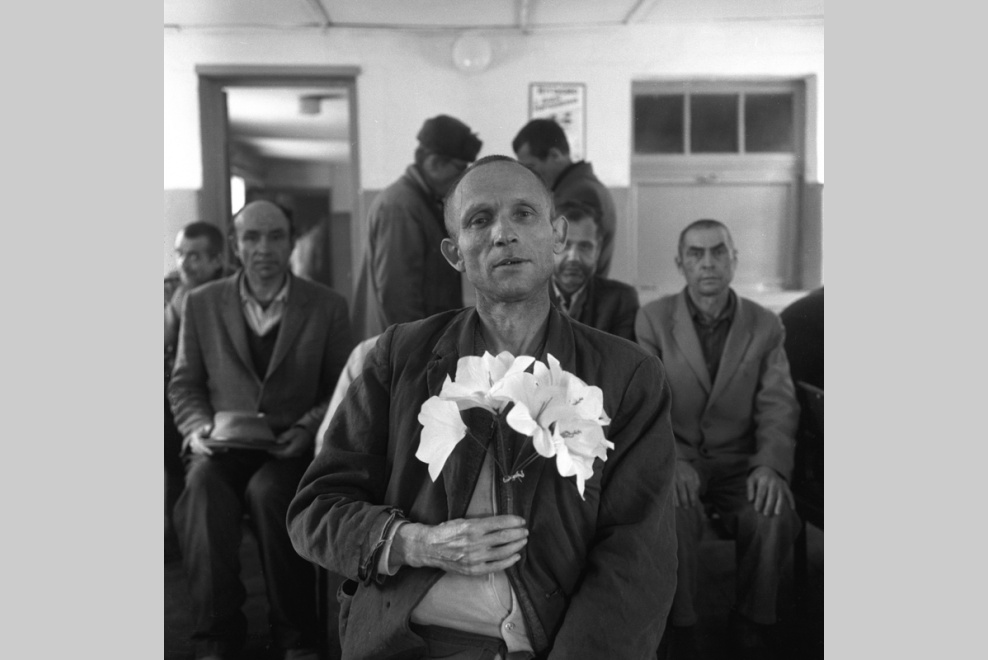
LILIES
In early 1999, by fortunate coincidence, I managed to get into a mental hospital. It was a coincidence because the “tour” to the psychiatric clinic was arranged for a beginner photojournalist from the UK.
Before that, in 1994, when I was photographing an ambulance crew at work, this subject was off-limits to photojournalists. Back then, I wasn’t ready for it and wouldn't have captured it the same way I did five years later.
We headed to the town of Ovruch in the Zhytomyr region. It was my second trip to a mental hospital, so I knew what to bring. Cigarettes and sweets are the best gifts for the patients. On my first trip, I shot a reportage about the patients' and medical staff's lives. After shooting more than twenty rolls of film, however, I wanted to do more than just observe; I wanted to intervene. We spent the night in a separate ward of the same building where the patients live.
The next morning, I was surprised to find that the patients, the medical staff, and we all looked the same. We laughed at ourselves because, in the hospital ward, we were all equal. Without his usual white coat, the sanitary worker wasn’t offended or surprised when I mistook him for a mental patient.
Once again, I started "shooting" with my modern digital camera at the clueless patients. Suddenly, I saw a bouquet of artificial lilies on the refrigerator and immediately knew what the series should be. I took an old, mechanical Rolleiflex camera loaded with black-and-white film out of my bag.
I sat each patient by the window, handed them a bouquet of white artificial lilies, and asked them to smile. Then, a big problem arose—not everyone understood what "smile" meant. So, I tried to make everyone laugh. Even the most seriously ill patients wanted to receive a bouquet and look into the camera lens. I took pictures for two days until the film ran out.
These people need very little: candy, cigarettes for the ward, flowers, or our smiles. They welcome each new person as children welcome parents they haven’t seen in a long time. Essentially, they are children who will never grow up. They are waiting for our attention. They are almost the same as us, but better. They are not cunning or envious; they cannot betray or deceive. One could say that they live by God’s commandments.
P.S. The head of the ward said it was a "laughter therapy session" and that his patient had emerged from a two-week state of depressive psychosis.
P.P.S. Later, I donated 100 black-and-white photographs to the clinic as keepsakes.